
THE COMPLETE GUIDE TO UTERINE FIBROID EMBOLIZATION (UFE)
Everything You Need to Know About Treating Fibroids Without Surgery or Losing Your Uterus
Home » Uterine Artery Embolization » UFE Complete Guide
If you are living with uterine fibroids — the heavy bleeding that keeps you home from work, the pressure that makes you look months pregnant, the constant trips to the bathroom, the pain during intimacy — and you have been told your best option is a hysterectomy, this guide is for you.
Uterine fibroid embolization is a minimally invasive procedure that shrinks fibroids by cutting off their blood supply — without surgery, without removing your uterus, and without the six-to-eight-week recovery that comes with a hysterectomy. It treats all fibroids simultaneously regardless of number or location, achieves 85 to 95 percent symptom improvement, and gets most women back to work in seven to ten days.
Despite these advantages, only 4 percent of fibroid patients nationally receive UFE. A 2024 survey found that only 17 percent of women with fibroids recalled being offered UFE as a treatment option. Many women discover UFE through their own research — not from their gynecologist. If that is how you found this page, you are not alone, and we are glad you are here.
This guide covers everything: how UFE works, whether you are a candidate, what the procedure feels like, how it compares to hysterectomy and myomectomy, what recovery really looks like (day by day), fertility considerations, cost and insurance, and answers to the most common questions we hear from patients.

- 1What Are Fibroids and Why Do They Cause Problems?
- 2What Is UFE and How Does It Work?
- 3Who Is a Candidate for UFE?
- 4The UFE Procedure — Step by Step
- 5UFE Success Rates and Long-Term Results
- 6How UFE Compares to Hysterectomy and Myomectomy
- 7Recovery: What the First Week Really Looks Like
- 8Fertility and Pregnancy After UFE
- 9Cost and Insurance Coverage
- 10Frequently Asked Questions
WHAT ARE FIBROIDS AND WHY DO THEY CAUSE PROBLEMS?
Uterine fibroids are non-cancerous growths that develop in or on the muscular wall of the uterus. They are extraordinarily common — affecting up to 80 percent of women by age 50 — and they are almost never cancer (less than 0.1 percent of fibroids are malignant).
Fibroids range from the size of a seed to larger than a grapefruit. They can grow as single tumors or in clusters, and their location determines which symptoms they cause. Submucosal fibroids (growing into the uterine cavity) cause the heaviest bleeding. Intramural fibroids (within the uterine wall) cause pressure and bulk symptoms. Subserosal fibroids (on the outer surface) cause pressure on the bladder and bowel.
The symptoms fibroids cause can range from mildly annoying to life-altering: heavy menstrual bleeding that soaks through pads or tampons every hour, periods lasting seven or more days, pelvic pressure and bloating that makes you look pregnant, frequent urination from pressure on the bladder, pain during intercourse, lower back pain, and fatigue from iron-deficiency anemia caused by chronic blood loss.
Black women develop fibroids two to three times more often than white women, at younger ages (60 percent by age 35), and with more severe symptoms. Yet research shows Black women are 45 percent less likely to receive minimally invasive treatment. This disparity is one reason awareness of UFE matters — every woman deserves to know all of her options.
The economic burden of fibroids is staggering: $34.4 billion annually in healthcare costs and lost productivity. But the personal burden — missed work, canceled plans, damaged relationships, exhaustion — is what actually drives women to seek treatment.
WHAT IS UFE AND HOW DOES IT WORK?
Uterine fibroid embolization (also called uterine artery embolization or UAE) works by blocking the blood vessels that feed fibroids. Without blood supply, fibroids soften, shrink, and stop causing symptoms. The uterus itself continues to function normally because it receives blood from multiple sources.
The procedure is performed by an interventional radiologist — a physician who specializes in using real-time imaging to guide instruments through the body’s blood vessels without surgical incisions. Here is how it works:
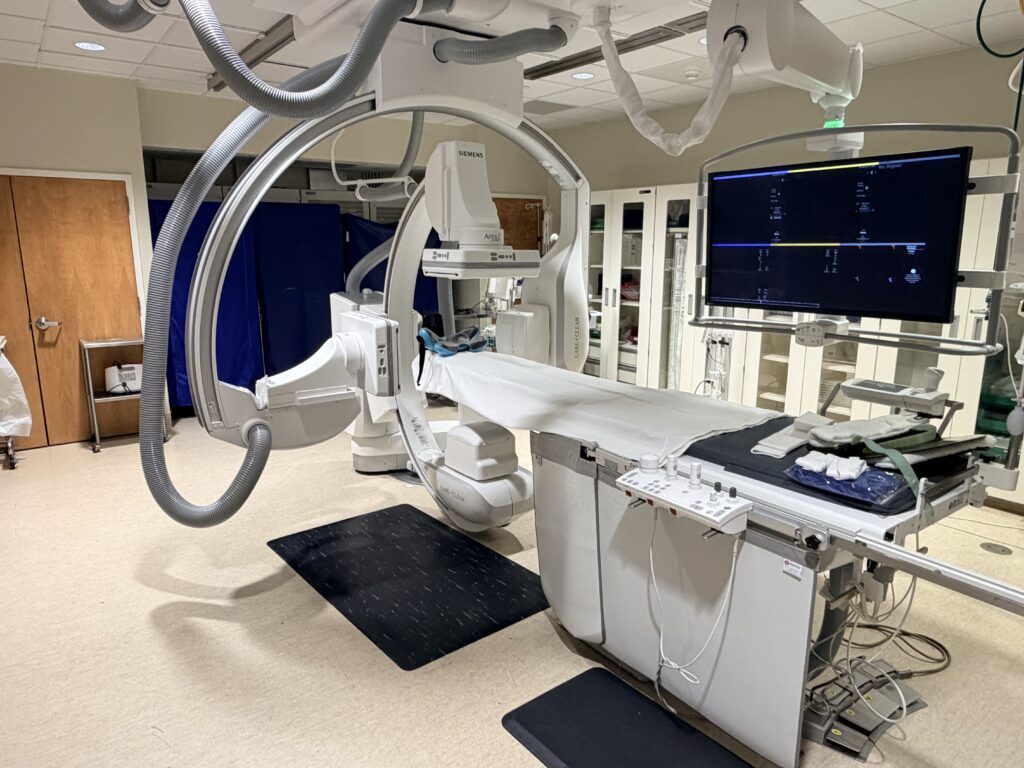
Dr. Bourgeois makes a tiny puncture — approximately two millimeters — in the wrist or groin. Through this puncture, a thin catheter is threaded into the arterial system and navigated using real-time X-ray guidance (fluoroscopy) to the uterine arteries. A small amount of contrast dye creates a detailed map showing exactly which vessels feed the fibroids. Microscopic particles are then injected through the catheter into these vessels. The particles lodge in the small arteries feeding the fibroids, blocking blood flow.
The key advantage of UFE is that it treats every fibroid simultaneously. Whether you have one fibroid or twenty, the embolization reaches them all because they share the uterine artery blood supply. Surgical options like myomectomy must identify and remove each fibroid individually — and may miss small ones embedded deep in the uterine wall.
Over the following weeks and months, fibroids soften and shrink. Average fibroid volume decreases by 42 to 52 percent, and uterine volume decreases by 35 to 52 percent within six months. Fibroids continue shrinking beyond this point. Symptom improvement — especially heavy bleeding — is often noticed within the first one to two menstrual cycles.

WHO IS A CANDIDATE FOR UFE?
Most women with symptomatic uterine fibroids are candidates for UFE. The best candidates typically include:
Women with heavy menstrual bleeding that disrupts daily life: If your periods are so heavy that you soak through a pad or tampon every hour, pass blood clots, or cannot leave the house during your period, UFE can provide dramatic relief. Studies show bleeding resolves in 83 to 92 percent of patients.
Women with bulk symptoms — pressure, bloating, urinary frequency: Fibroids pressing on the bladder, bowel, or surrounding structures cause the “looking pregnant” sensation, constant need to urinate, and lower back pain. Bulk symptoms improve in 82 to 92 percent of UFE patients.
Women who want to keep their uterus: Whether for fertility, personal, cultural, or emotional reasons, many women want to preserve their uterus. UFE treats fibroids while leaving the uterus intact and functional. You do not need to justify your desire to keep your uterus to anyone.
Women who have been told hysterectomy is their only option: If you were told the only solution is to remove your uterus and you are uncomfortable with that recommendation, UFE deserves consideration. Seventy-five percent of fibroid removals are still hysterectomies despite effective uterus-preserving alternatives being available.
Women with multiple fibroids: UFE treats all fibroids simultaneously regardless of number or location. Women with many fibroids may actually benefit more from UFE than myomectomy, which requires surgically identifying and removing each one.
Women who cannot undergo surgery: Medical conditions that increase surgical risk — heart disease, lung disease, obesity, blood clotting disorders — may make UFE the safer option. UFE uses conscious sedation rather than general anesthesia and involves minimal blood loss.
UFE is generally not recommended for women with pedunculated subserosal fibroids (those hanging from the uterus on a stalk), active pelvic infection, known or suspected gynecologic malignancy, or those who are currently pregnant. Women actively planning pregnancy in the near future should discuss both UFE and myomectomy with their care team, as myomectomy has better documented fertility outcomes.
The UFE Procedure — Step by Step
Understanding what happens eliminates the fear of the unknown. Here is your complete UFE experience:
Consultation and Planning
Dr. Bourgeois reviews your imaging (MRI is ideal for mapping fibroid number, size, and location), symptom history, lab work, and goals. He discusses whether UFE is the right approach for your specific fibroid pattern or whether surgical referral would serve you better. Pre-procedure blood work (CBC, metabolic panel, coagulation studies) is obtained. You receive specific instructions about fasting, medication adjustments, and what to bring on procedure day.
Arrival and Preparation
You arrive at the hospital and check in at day surgery. An IV is placed, monitoring equipment is attached, and the IR team reviews the plan with you. You receive conscious sedation through your IV — this puts you in a comfortable, drowsy state. You are breathing on your own but relaxed and unlikely to remember details.
The Embolization (60–90 Minutes)
A tiny puncture is made in the wrist or groin and numbed with local anesthetic. A thin catheter is guided through the arterial system to the uterine arteries using real-time X-ray imaging. Contrast dye maps the blood supply to the fibroids. Microscopic particles are injected to block the feeding arteries. The process is repeated on both sides. You may feel warmth or mild cramping during the embolization — this is normal.
Recovery and Discharge
After the procedure, you are taken to a recovery room where pain management is the top priority. Post-procedure cramping is expected and can be significant in the first 12–24 hours — managed with IV pain medication (often a PCA pump that lets you control doses). Most patients stay overnight, which we recommend. This allows optimal pain control and monitoring during the most uncomfortable window. Same-day discharge is possible but not preferred.
UFE SUCCESS RATES AND LONG-TERM RESULTS
The clinical evidence for UFE is extensive, built on over 100,000 procedures worldwide and anchored by the FIBROID Registry (3,000+ patients) and multiple randomized controlled trials including the landmark EMMY and REST trials.
Technical success — meaning successful embolization of both uterine arteries — is achieved in 96.2 percent of procedures. Overall symptom improvement is reported by 85 to 95 percent of patients.
Symptom-specific results are compelling. Heavy menstrual bleeding resolves in 83 to 92 percent of patients, with Society of Interventional Radiology guidelines citing greater than 90 percent improvement. Bulk symptoms including pelvic pressure and urinary frequency improve in 82 to 92 percent of cases. Pelvic pain improves in 78 to 84 percent. A long-term quality-of-life study with seven-year median follow-up found median bleeding impairment scores dropped from 7 to 0 and pain scores dropped from 5 to 0.
Average fibroid volume shrinks by 42 to 52 percent, and uterine volume decreases by 35 to 52 percent within six months. Fibroids continue shrinking beyond this point.
Long-term durability is strong. Symptom control persists at 73 to 80 percent at five years and 65 to 70 percent at ten years. The annual recurrence rate after the first year is approximately 3 to 4 percent per year. Retreatment (repeat UFE, myomectomy, or hysterectomy) occurs in roughly 20 percent of patients within five years — comparable to the 22 percent or higher recurrence rate after myomectomy.
The FIBROID Registry reported an 85.7 percent patient recommendation rate at three years — meaning the vast majority of women who underwent UFE would recommend it to others.
Internal link: For a detailed comparison with surgical options, see our UFE vs. Hysterectomy page → /ufe-vs-hysterectomy/
HOW UFE COMPARES TO HYSTERECTOMY AND MYOMECTOMY
Most women considering UFE are weighing it against one or both surgical options. Here is a brief overview — detailed comparisons are available on our dedicated pages.
UFE vs. Hysterectomy
UFE preserves your uterus. Recovery is 7-10 days versus 6-8 weeks. Hospital stay is overnight versus 2-5 days. Major complication rate is 1.3-4.8 percent versus 14.5-20 percent. Symptom resolution is 85-95 percent versus nearly 100 percent (because the uterus is removed entirely). Hysterectomy eliminates any possibility of future pregnancy and carries risks of surgical menopause, pelvic floor changes, and long-term hormonal effects. For women who want definitive, permanent resolution and have no desire for future fertility, hysterectomy remains an excellent option. For everyone else, UFE deserves serious consideration. Detailed comparison → /ufe-vs-hysterectomy/
UFE vs. Myomectomy:
Both preserve the uterus. Myomectomy has better documented fertility outcomes (48-56 percent pregnancy rate versus 23-41 percent for UFE) and is the preferred option for women actively planning pregnancy. However, myomectomy requires general anesthesia, has a longer recovery (2-6 weeks), carries higher complication rates (3-20 percent), and must identify and remove each fibroid individually — potentially missing small ones. UFE treats all fibroids simultaneously with a shorter recovery. For women who are not planning pregnancy or for whom myomectomy is technically difficult (many large or deeply embedded fibroids), UFE may be the better choice. Detailed comparison → /ufe-vs-myomectomy/
RECOVERY: WHAT THE FIRST WEEK REALLY LOOKS LIKE
Recovery: What the First Week Really Looks Like
In Hospital — The Most Uncomfortable Window
This is the most uncomfortable window. Cramping is managed with IV pain medication. You may experience nausea. Low-grade fever is normal. Rest and let the medications work.
Post-Embolization Syndrome
Cramping transitions from acute to a deep, dull ache. Post-embolization syndrome — cramping, low-grade fever, fatigue, and mild nausea — affects approximately 50 percent of patients and peaks during this window. Oral pain medication and anti-inflammatories manage symptoms.
Significant Daily Improvement
Energy returns. Cramping fades. Most women return to desk work by day 7–10. Physically demanding jobs may require the full two weeks.
Gradual Return to Full Activity
Continue gradual return to full activity. Light exercise can resume at two weeks. Heavy lifting and vigorous exercise should wait until four to six weeks.
Progressive Symptom Improvement
Fibroids continue shrinking. Many women notice each period is lighter and less painful than the last. Follow-up MRI at six months to measure fibroid and uterine volume reduction.
FERTILITY AND PREGNANCY AFTER UFE
This is one of the most important and emotionally complex topics for women considering UFE. We believe in giving you complete, honest information.
UFE preserves your uterus, which means pregnancy remains biologically possible after the procedure. Published pregnancy rates after UFE range from 23 to 41.5 percent. The Pisco study of 359 infertile women treated with partial UFE reported a 41.5 percent pregnancy rate and 131 live births.
However, UFE is not recommended as the first-line treatment for women actively planning pregnancy. Myomectomy has better documented fertility outcomes, with pregnancy rates of 48 to 55.9 percent. Guidelines from the Society of Interventional Radiology and the American College of Obstetricians and Gynecologists position myomectomy as preferred for fertility preservation.
The risk of premature menopause after UFE is approximately 3 percent for women under 45 and up to 15 percent for women over 45. The FEMME trial found no significant difference in ovarian reserve (measured by FSH hormone levels) between UFE and myomectomy patients at twelve months, which is reassuring for younger women.
Miscarriage rates after UFE (approximately 20 percent) are somewhat higher than the general population. This is an area where the data is still evolving, and Dr. Bourgeois discusses it candidly during consultations.
The bottom line: If you are actively trying to conceive or planning pregnancy in the near future, myomectomy should be your first consideration. If you are not planning pregnancy, if myomectomy is not feasible for your fibroid pattern, or if preserving the option of future fertility matters to you even if pregnancy is not imminent, UFE preserves that possibility while providing excellent symptom relief.
Internal link: For detailed fertility data and comparisons, see our UFE and Fertility page → /ufe-fertility/


COST AND INSURANCE COVERAGE
UFE is covered by all major insurance plans when medically indicated. Here is what you need to know:
Blue Cross Blue Shield of Alabama — which holds over 90 percent of the commercial insurance market in Alabama — covers UFE. TRICARE covers UFE as a medically necessary procedure for military families and retirees. Medicare and Medicaid provide coverage. UnitedHealthcare, Aetna, Cigna, Humana, and other commercial plans cover UFE with prior authorization.
Typical out-of-pocket costs with insurance range from $2,000 to $3,000, depending on your specific plan deductible and coinsurance. Without insurance, UFE typically costs $10,000 to $15,000 — compared to $32,000 to $35,000 for a hospital-based hysterectomy.
Beyond the procedure cost, UFE saves significantly on indirect costs: seven to ten days off work versus six to eight weeks for hysterectomy. For working women, that difference represents thousands of dollars in preserved income.
Our team verifies your insurance, obtains prior authorization, and provides a cost estimate before your procedure date.
Internal link: For detailed insurance guidance including TRICARE and VA, see our UFE Cost and Insurance page → /ufe-cost-insurance/
Frequently Asked Questions
Everything women in Huntsville ask about uterine fibroid embolization.
UFE is a minimally invasive procedure that shrinks fibroids by blocking their blood supply. A thin catheter is inserted through a tiny puncture in the wrist or groin and guided to the uterine arteries using real-time X-ray imaging. Microscopic particles are injected to block blood flow to the fibroids. The procedure takes 60 to 90 minutes under conscious sedation, and most patients go home the next morning. UFE treats all fibroids simultaneously regardless of number or location, preserves the uterus, and achieves 85 to 95 percent symptom improvement.
Most women return to desk work in 7 to 10 days and physically demanding work in 1 to 2 weeks. The first 24 hours involve the most intense cramping, managed with IV pain medication during an overnight hospital stay. Post-embolization syndrome — cramping, low-grade fever, and fatigue — affects about 50 percent of patients during days 1 through 5 and resolves on its own. Compare this to 6 to 8 weeks of recovery after hysterectomy or 2 to 6 weeks after myomectomy.
Read our detailed recovery timelineUFE achieves 85 to 95 percent overall symptom improvement. Heavy bleeding resolves in over 90 percent of patients. Bulk symptoms like pressure and urinary frequency improve in 82 to 92 percent. Fibroid volume shrinks by 42 to 52 percent within six months and continues beyond. At five years, 73 to 80 percent of patients maintain symptom control. The FIBROID Registry of over 3,000 patients reported 85.7 percent of women would recommend UFE at three years.
The first 24 hours involve significant cramping — patients often compare it to intense menstrual cramps or labor pains. This is managed with IV pain medication during your overnight stay. We are honest about this because patients who are prepared cope better than those who are surprised. By days 3 to 5, cramping transitions to a dull ache managed with oral medication. Most women describe the experience as very manageable after the first day, and many say it was easier than they expected. The number one recovery tip from patients: request anti-nausea medication proactively.
UFE preserves the uterus, so pregnancy remains possible. Published pregnancy rates after UFE range from 23 to 41.5 percent. However, myomectomy has better fertility outcomes (48 to 56 percent pregnancy rate) and is recommended as the first-line treatment for women actively planning pregnancy. For women not planning immediate pregnancy but wanting to preserve the option, UFE maintains that possibility while providing excellent symptom relief. The FEMME trial found no significant difference in ovarian reserve between UFE and myomectomy at 12 months.
Read our fertility guideYes. UFE is covered by Blue Cross Blue Shield of Alabama (90 percent or more of the local market), TRICARE, Medicare, Medicaid, UnitedHealthcare, Aetna, Cigna, and virtually all major commercial plans. Typical out-of-pocket with insurance is $2,000 to $3,000. Our team verifies your coverage and handles prior authorization.
See detailed cost and insurance informationIt depends on your priorities. UFE preserves your uterus with 7–10 day recovery, 1.3–4.8 percent major complication rate, and 85–95 percent symptom resolution. Hysterectomy provides nearly 100 percent symptom resolution but requires 6–8 week recovery, 14.5–20 percent complication rate, and permanently removes the uterus. For women who want to keep their uterus, minimize recovery, or avoid major surgery, UFE is typically the better choice. For women wanting definitive permanent resolution with no desire for future fertility, hysterectomy is excellent.
Read our full side-by-side comparisonThis is one of the most common frustrations we hear — and it is valid. UFE is performed by interventional radiologists, not gynecologists. OB/GYNs are surgeons trained to perform surgical solutions like hysterectomy and myomectomy. Many are unfamiliar with UFE or do not routinely discuss it. A 2024 survey found only 17 percent of fibroid patients recalled being offered UFE. This is not a criticism of gynecologists — they are excellent physicians. It reflects the reality that different specialists offer different treatments. Dr. Bourgeois is happy to coordinate with your existing gynecologist.
For women under 45, the risk of premature ovarian failure is approximately 3 percent. For women over 45, the risk increases to up to 15 percent. The FEMME trial found no significant difference in FSH hormone levels between UFE and myomectomy patients at 12 months, which is reassuring. UFE targets the blood supply to fibroids specifically — the ovaries receive blood from separate vessels. However, in some cases, microscopic particles may reach ovarian blood supply, which is why the risk is slightly higher for older women whose ovarian blood supply may be more dependent on uterine artery branches.
Treated fibroids rarely regrow if they are completely infarcted (blood supply fully blocked). However, new fibroids can develop from different locations in the uterus over time. At five years, 73 to 80 percent of patients maintain symptom control. The retreatment rate is approximately 20 percent within five years — comparable to the 22 percent or higher recurrence rate after myomectomy. If retreatment is needed, options include repeat UFE, myomectomy, or hysterectomy.
You receive conscious sedation through an IV (awake but relaxed and comfortable). A tiny 2-millimeter puncture is made in the wrist or groin. A thin catheter is threaded through the arterial system to the uterine arteries using real-time X-ray guidance. Contrast dye maps the blood supply. Microscopic particles are injected to block the arteries feeding the fibroids. The process is repeated on both sides. The catheter is removed and a small bandage applied. The entire procedure takes 60 to 90 minutes. No incisions. No stitches.
Most patients report improved sexual health after UFE as fibroid symptoms resolve. Pain during intercourse caused by fibroids typically improves. Heavy bleeding that disrupted intimacy resolves. Pressure symptoms that caused discomfort decrease. There is no evidence of negative sexual function impact from UFE. Many women describe regaining a part of their life that fibroids had taken away.
Yes. Black women develop fibroids two to three times more often than white women, at younger ages (60 percent by age 35 versus 40 percent by age 35 for white women), and with more severe symptoms. Despite this higher prevalence, research shows Black women are 45 percent less likely to receive minimally invasive treatment like UFE. Every woman — regardless of race — deserves to know about all available treatment options. Dr. Bourgeois is committed to equitable access to care.
Yes. Dr. Austin Bourgeois performs UFE in Huntsville, eliminating the 100-plus-mile drive to Birmingham or Nashville that was previously required. He accepts Blue Cross Blue Shield of Alabama, TRICARE, Medicare, and all major insurance plans. The practice serves women throughout North Alabama including Decatur, Athens, Florence, Madison, and southern Tennessee.
You do not need a referral to schedule a consultation with Dr. Bourgeois for most insurance plans. TRICARE Prime members need a referral from their primary care manager. BCBS Alabama and most commercial plans allow self-referral to specialists with prior authorization (which our team handles). Call our office or complete the contact form — we will verify your insurance and guide you through the process.
Have more questions? Dr. Bourgeois is happy to discuss your specific situation.
Schedule Your ConsultationSCHEDULE YOUR UFE CONSULTATION
If fibroids are controlling your life and you are tired of being told your only option is a hysterectomy, you deserve to know about UFE. Dr. Austin Bourgeois is the only interventional radiologist in Huntsville offering dedicated fibroid embolization — eliminating the 100-mile drive to Birmingham or Nashville.
Call or complete the form below. Bring your recent imaging (MRI preferred) and lab work. Dr. Bourgeois will review your case, discuss your options honestly — including whether UFE, myomectomy referral, or other approaches best fit your situation — and help you make an informed decision about your care.